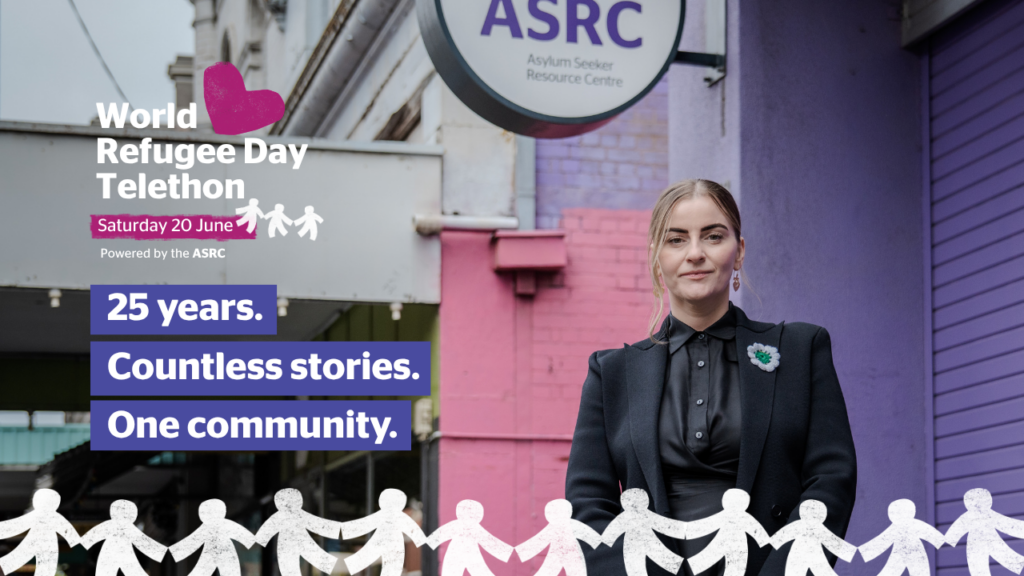
Senada Suljagic’s 25-Year Journey from Child Refugee to ASRC Telethon Hero
Senada Suljagic’s connection to the Asylum Seeker Resource Centre (ASRC) stretches back 25 years to the early days of the organisation, when it operated out of a small, hole-in-the-wall shop in Footscray.
Senada recently attended a fundraising dinner at the ASRC where it is now, across the road from that little shop, and when she looked down the road toward the station, a sudden memory popped into her mind. Walking inside the centre of the organisation that has been a big presence in her life throughout her studies and professional life, she realised the organisation she knew and respected was the same as the little shop she had visited as a child.
Today, when Senada returns to the ASRC for her interview as the 2026 ASRC Telethon Hero, she walks in with the Flower of Srebrenica pinned to her lapel. Her father and both grandfathers were killed in the Srebrenica genocide in July 1995, when more than 8,000 Bosniak Muslim men and boys were killed during one of the most harrowing events of the Bosnian war.
Senada, her mother, brother and grandmother arrived in Melbourne in 2000, after years of displacement across Europe, moving between temporary accommodations. In Slovenia, they lived in army barracks where food was rationed to them at mealtimes. In Germany, they lived on temporary permissions that had to be renewed every six weeks, relying on food vouchers and pre-packed hampers where they had to try and swap items with others to get what they needed.
Major charities in Australia worked on the same principle of giving out hampers, but ASRC operated differently. Instead of receiving a handout, families were able to walk around the shop with their own trolley and select their own food. For Senada, who was only 12 or 13 at the time, “it just felt like going shopping.” The ASRC Foodbank model based on dignity of choice meant that the family could choose food items that suited their culture and habits.
Looking back, Senada reflects on how incredibly difficult those early years were for her mother. By 2000, the community services that had helped earlier Bosnian arrivals settle in Australia had been dismantled. They had no mobile phones or internet and everyday tasks became overwhelming logistical challenges. No one was there to explain how to navigate the school system or where people could go to buy certain things.
“I work with charities that support newly arrived refugees here,” says Senada. “I remember helping someone set up a washing machine and we went to a hardware store to buy a little plug. And I was thinking, who did this for my mum? Who would have gone to a hardware store with her?”
It was only when the family attended their official citizenship ceremony that Senada’s mother finally felt safe enough to take a breath, knowing her children could securely attend university, something that was denied to them while on temporary visas in Europe.
Senada studied law and pursued a successful career in accounting. As a teenager and during her studies, she noticed that people seeking asylum were constantly treated as a political football by successive governments, with public discourse shifting back and forth between offshore processing, Christmas Island, and “Stop the Boats” rhetoric.
Yet, throughout these hostile political narratives, the ASRC remained the one constant in the background of Senada’s life, offering a rational, compassionate voice advocating for the rights of people who did not have a voice. “The organisation never singled out one group or faith, it advocated for all refugees equally. They gave you a voice, and it gives you confidence to speak up as well,” she observed.
Senada’s understanding of justice and advocacy was shaped by her family’s history and the survivors who kept those stories alive. She speaks openly about her background to challenge narratives that blame migrants for systemic failures. Senada emphasises that conflict can destroy a society overnight and anyone can become a refugee. Her own father had been a university professor living a standard, modern life in an advanced society until war suddenly broke out.
Senada also highlights the double standard she experiences as an educated white, European refugee, noting the public easily categorises her as a “good migrant.” She firmly rejects this division, stating that all refugees, wherever they come from, want the exact same things for their children that her mother wanted for her: safety, normality and a chance to contribute.
Walking back into the ASRC decades later, Senada was struck by how much the organisation had grown. While it is bittersweet that the demand has expanded rather than shrunk, its growth proves that the hostile political rhetoric does not represent the consensus of average Australians, who continue to welcome people seeking asylum and refugees.
Senada’s story is one of a million stories of refugees who have settled in Australia and one of tens of thousands people seeking asylum who passed through the ASRC, received practical support and went on to rebuild their lives in Australia. Now, as the ASRC’s 2026 Telethon Hero, she hopes her journey demonstrates the lasting impact that dignity and community care can have on a person rebuilding their life from scratch.
Join us on Saturday 20 June for the World Refugee Day Telethon, live from our centre in Foostcray, from 7am to 11pm.

Connect with us
Need help from the ASRC? Call 03 9326 6066 or visit us: Mon-Tue-Thur-Fri 10am -4pm. Closed on Wednesdays.