Meet Noha, the 2026 Feast for Freedom Hero Cook from Palestine
Noha, one of our two Feast for Freedom Hero Cooks this year, was lucky to arrive in Australia with her two daughters just ten days before the bombing in Gaza began in 2023. They came to Australia for her daughter’s university studies and they carried with them big dreams for the future. Noha’s eldest is studying biomedical engineering and her youngest finished Year 12 last year.
But as destruction rained on their homeland, their hearts grew heavier, with the rest of their family, including Noha’s husband, still living there. “No one in Gaza is okay,” says Noha, “but for now, my husband is safe and that is something I hold on to.”
Leaving Gaza and Palestinian culture was hard. “You have to hold it tightly, especially for your children,” says Noha. “Older people like me can hold onto memories, but young people can lose things quickly – language, culture, traditions.”
Noha wants to keep these traditions alive for her daughters, especially the Arabic language which is not an easy language to learn and she has already noticed her daughters forgetting some words. She wants her daughters to be proud of their heritage and remember Palestine with its sandy shores and its scent of citrus and olive.
Food is another big part of Palestinian identity and culture. Palestinian cuisine is rich and full, belonging to the Levant or Belad al-Sham – Syria, Lebanon, Jordan and Palestine all have similar, yet distinct cuisines. For example, moussaka is a pan-Mediterranean dish, but Noha makes it the Palestinian way. Noha laments that Palestinian food never had the chance to reach the world as it is always overshadowed by bad news. She is determined to right this wrong and bring Palestinian dishes to as many people as possible.
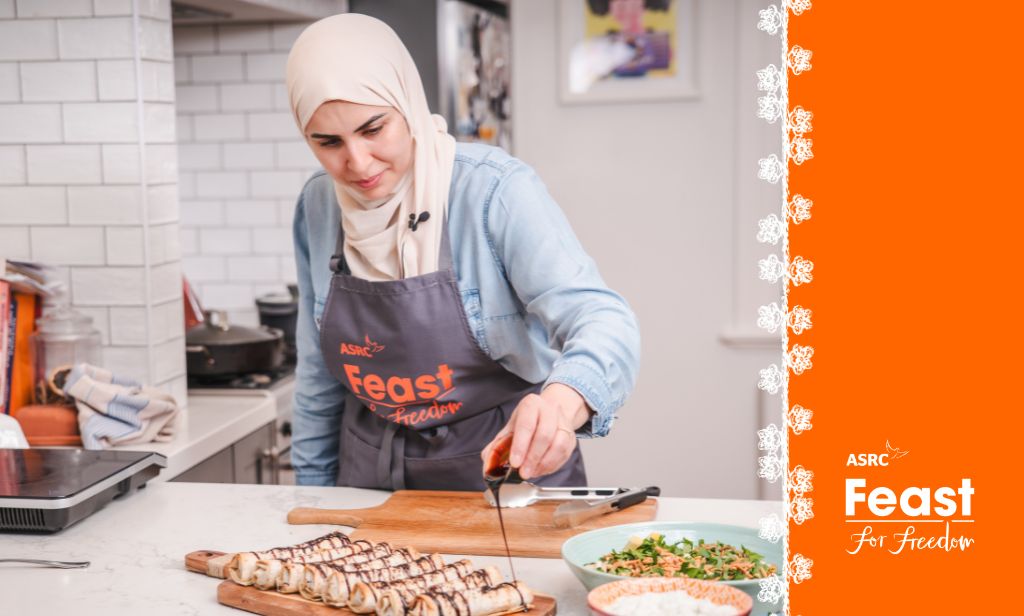
If Noha was to choose one dish that represents Palestine, she would choose Musakhan: “For me, it is the real Palestinian dish.” Musakhan is made with traditional Palestinian ingredients, olive oil and sumac, and Noha makes a more modern version of it – rolled up and easier to eat.
Sumac is one of the ingredients that represent home to Noha. The other is za’atar, a quintessential aromatic herb or herb blend of Levantine cuisines. “Every morning, for breakfast we’d have the famous za’atar w zeit (za’atar with olive oil) or za’atar with bread,” reminisces Noha. “I grew up with za’atar.”
The other memory of home is olive oil. Gaza has been a centre of olive cultivation for over more than 6,000 years, and olives are considered a cornerstone of Palestinian culture and identity. “My family had a big piece of land in Gaza, with maybe 80 or 90 olive trees,” says Noha. “Every year at harvest time, we would collect all the olives, take them to be pressed and make the oil to last us the whole year. It was like a celebration for us. I want to go back to that one day. I miss the smell of the soil, the clay.”
When Noha cooks, she thinks of her grandmother, her mother, her family house in Gaza. “I think of all of us in the kitchen together, working side by side,” she says. “I often say that Palestine is more than its struggles – it is a recipe of love. It’s more than just food, it’s my roots, my soul.”
It is Noha’s fervent wish that people in Australia could better understand Palestinian culture through her food and know that Palestine stands for so much more than turmoil and conflict.
Register now to host a Feast for Freedom before 30 April and get access to Noha’s Palestinian recipes and so much more!

Connect with us
Need help from the ASRC? Call 03 9326 6066 or visit us: Mon-Tue-Thur-Fri 10am -4pm. Closed on Wednesdays.