Federal Budget 2026-27 Explainer – What the budget means for refugees and people seeking asylum
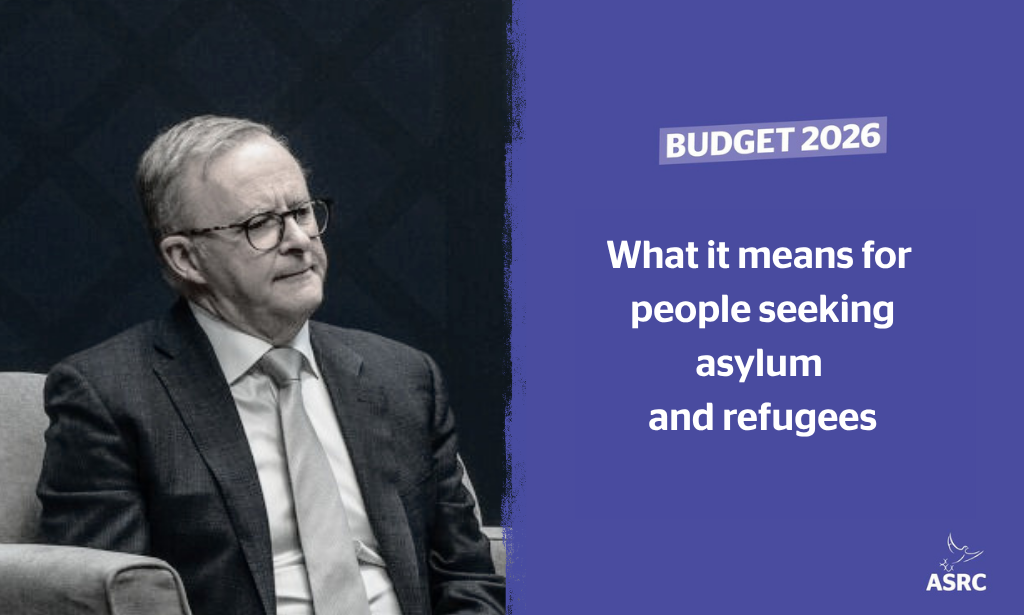
The 2026–27 Federal Budget leaves refugees and people seeking asylum behind once again, with the Albanese Government continuing to prioritise spending on offshore detention and punitive migration policies over freedom, fairness and safety.
Offshore detention spending alone blew out by almost $400 million over the past year, bringing total spending for 2025–26 to close to $1 billion.
There is no mention of the Nauru deal in the budget papers, meaning the Government has chosen to remain secretive about the cost and nature of their separate deportation deal with Nauru.
One positive element of the Government’s key migration announcements was an $85.2 million investment in improving recognition of migrant skills. This includes consultation on the establishment of a Skills Migration Commissioner, a reform long called for by the Activate Australia’s Skills campaign, of which the ASRC is a member.
However, the budget allocates more than 21 times that amount, $1.8 billion, to offshore detention over the next four years.
While there is a small increase to the Status Resolution Support Services (SRSS) program which is up $6 million to $26 million, the payment amount remains far below Centrelink rates and well beneath the poverty line – and only a tiny percentage of people seeking asylum are even eligible.
This is due to the Albanese Government not restoring the cuts made by Dutton under the Morrison Government for a program that in 2016-2017 was funded at $369.7 million compared to $26 million today, despite the numbers of people seeking asylum in Australia being at a decade high.
While the Government’s decision to prioritise onshore visa applications acknowledges the urgent need to provide certainty to people already living in Australia on temporary visas, it will push family members fleeing war and conflict further to the back of the queue.
The humanitarian intake number for 2026–27 remains unclear. However, what is clear is that the Government has failed to increase the program to the 27,000 places promised in the Labor Party platform, despite record levels of global displacement and growing humanitarian need.
Key Takeaways:
- The offshore detention budget blew out to nearly a billion dollars over the past year (an overspend of nearly $400 million).
- The only certainty provided about the humanitarian intake is that it has not increased – but the number remains unclear
- Onshore applications will be prioritised in the family and skilled streams, pushing family members fleeing conflict zones to the back of the queue
- There is a win for skilled migrants with investment in streamlining skills recognition, but over 13,000 people seeking asylum are still locked out of work
- A small increase to SRSS, the only support program seeking asylum can access, but payments remain far below Centrelink rates, and only a tiny fraction of people are eligible – with thousands continuing to live in forced destitution
- Modest investment in reducing backlogs in Tribunal and Court systems
- Cuts to the funding of the Australian Human Rights Commission
Offshore Detention Budget Blowout
The budget papers revealed that the Government’s spending on offshore detention has enormously blown out over the past 12 months. They projected a spend of $581 million in the last budget for 2025-26, but instead they spent almost one billion dollars over the year. This is the seventh consecutive budget with overspending on offshore detention.
The forward estimates are projecting costs in offshore processing to decrease towards the financial year 2029-30, but still projects a breathtaking spend of $1.8 billion over the coming four years, even without the further cost blow-outs that we expect. Over the coming year alone, the Government has budgeted over $600 million.
There are no current public figures as to how many people are currently on Nauru, but the ASRC Detention Rights Advocacy Program estimates that there are between 100-104 who have been transferred there under Australia’s offshore processing regime. The majority are living in the Nauruan community and a smaller number detained inside the Regional Processing Centre. This means that the Government’s projected spending for the coming year is at least $5.8 million per person.
Despite this extraordinary spending, people on Nauru are currently expected to survive on just $260 per fortnight to cover food, drinking water, phone credit, internet and other basic necessities.
Evidence provided to the Senate inquiry into offshore processing last week, along with reports from people detained there, describe people regularly going hungry, being unable to afford enough fresh food, and experiencing worsening physical and mental health due to inadequate healthcare and prolonged uncertainty. People have reported untreated medical conditions, limited access to specialist and mental healthcare, and severe psychological deterioration, raising serious questions about where this extraordinary amount of public money is actually going.
Humanitarian intake unclear as families fleeing conflict pushed back in queue
The Federal Budget does not confirm the size of Australia’s Humanitarian Program for 2026–27, creating further uncertainty at a time when global displacement has reached record levels. The only thing that is clear is that the Government has not increased the program to the 27,000 places promised in the Labor Party platform.
The Government has confirmed the permanent Migration Program will remain at 185,000 places for 2026–27. Within that unchanged intake, it will prioritise onshore visa applications across both the Skill and Family streams, allocating 129,590 places to migrants already living in Australia, while the remaining 55,110 offshore places will predominantly go to highly skilled migrants. The Government has framed this measure as a way to place downward pressure on net overseas migration, an issue that has become increasingly politicised in public debate.
The decision to prioritise onshore applications reflects one reality the Government has correctly identified – there are many people seeking asylum and others already living in Australia, who have been trapped in endless limbo for years and urgently need certainty about their future. However, prioritising onshore applications in the family stream risks pushing family members trying to escape war and conflict even further down the queue, including relatives of Australians from refugee backgrounds desperately trying to reunite with loved ones. Australia has the capacity to both provide permanency to people already living in the community and ensure families fleeing conflict can access timely pathways to safety and reunification.
A win for skilled migrants, but people seeking asylum still locked out of work
The Federal Budget includes welcome investment in improving recognition of migrant skills, including $85.2 million over four years for faster and more flexible skills assessments, streamlined licensing pathways for priority trades, improved recognition of onshore qualifications and trade experience, and stronger oversight of skills assessing authorities. The Government will also consult on the establishment of a Skills Migration Commissioner, a reform long called for by the Activate Australia’s Skills campaign, of which the ASRC is a member.
These measures are a welcome recognition that migrants already living in Australia have valuable skills, qualifications and experience that should not be wasted. The reforms are aimed at reducing barriers to employment and helping address workforce shortages, particularly in priority sectors. The ASRC regularly works with people who are doctors, lawyers, teachers, nurses or have other skills critical to Australia, but have been unable to have their qualifications recognised and are therefore working in low-skilled occupations like cleaning, catering and factory work.
However, these reforms only go some way towards addressing the enormous missed opportunities within Australia’s migration system, given there are still nearly 13,000 people seeking asylum living in the community who the Albanese Government does not allow to work. While the Government is investing in recognising migrant skills and improving workforce participation, thousands of people seeking asylum remain deliberately excluded from the labour market and denied the ability to support themselves, study, contribute their skills and build stable futures in the communities they are already part of.
The contrast in spending makes the Government’s priorities clear. While the budget includes $85.2 million to improve recognition of migrant skills and workforce participation, more than $1.8 billion – 21 times this amount – has been allocated to locking people up in offshore detention. At a time when Australia is facing workforce shortages and cost of living pressures, the Government continues to spend vastly more on detention, secrecy and exclusion than on helping people already living in Australia build stable futures and contribute to the economy.
Still no real safety net for people seeking asylum
The Federal Budget includes a small increase in funding for the Status Resolution Support Services (SRSS) program, with funding rising from $20.2 million in 2025–26 to $26.1 million in 2026–27. While any increase in support for people seeking asylum is welcome, the additional funding reverses only a tiny fraction of the enormous cuts made to the program under Peter Dutton, which drastically slashed access to financial support and pushed many people into poverty and homelessness.
There are no mainstream Centrelink payments available to people seeking asylum. SRSS remains the only support payment available to people seeking asylum living in the community. However, the payment rate remains just $44 per day, well below Centrelink rates and far beneath the poverty line. Restrictive eligibility criteria also mean only a tiny proportion of people seeking asylum are able to access the program at all, despite many being subject to ‘no work’ visa conditions and experiencing housing insecurity, complex health needs and forced destitution.
The ASRC continues to advocate for people seeking asylum to have access to mainstream social safety nets and support services, rather than being forced to rely on a separate, deeply inadequate system that leaves many people unable to meet basic living costs and forces them to depend on charity support to survive. While the Albanese Government committed in the Labor Platform to ensuring people seeking asylum can access appropriate support while their claims are assessed, the current SRSS program continues to fall far short of what is needed for people to live safely and with dignity.
Modest measures for fast and efficient processing
The Federal Budget includes a modest increase in funding for the Administrative Review Tribunal (ART), with funding rising to $335 million in 2026–27, and an increase in staffing from 993 to 1230 staff members. There is also an additional $74.2 million over four years for the Federal Court of Australia (FCA) and Federal Circuit and Family Court of Australia (FCFCOA) to improve the efficiency of judicial review processes for migration matters.
This investment comes in response to severe and growing backlogs across Australia’s refugee review system, caused by long term under-investment. The median time for the Administrative Review Tribunal to finalise protection visa cases is approximately four years, while judicial review matters can take up to seven years to reach a final court outcome. During this time, people seeking asylum are left trapped in prolonged uncertainty, unable to properly plan their lives and in many cases prevented from working, studying or accessing a safety net due to restrictive visa conditions.
The additional court funding will support the development of a new pathway to address judicial review backlogs, digital system improvements, and duty lawyer assistance at the Sydney and Melbourne FCFCOA registries. While this investment is welcome and long overdue, access to legal assistance remains limited, particularly for people outside New South Wales and Victoria or those facing language, travel and other barriers to navigating a highly complex legal system. The most effective way to ensure refugee claims are processed both fairly and efficiently is to provide people seeking asylum with access to legal assistance from the beginning of their application and ensure the Tribunals and Courts are properly resourced to deal with reviews within a reasonable timeframe.
National Anti-Racism Framework undermined by Human Rights Commission cut
At a time when Australia urgently needs a strong national response to racism and social division, the Federal Budget reduces total funding for the Australian Human Rights Commission (AHRC) by $9.425 million, bringing total resourcing down to $67.5 million. The funding cut comes after the AHRC has strongly advocated for the development and implementation of a National Anti-Racism Framework, a critical long-term plan aimed at addressing racism in all aspects of Australian life.
The ASRC has consistently supported the urgent implementation of the National Anti-Racism Framework, recognising that racism, political scapegoating and fear-based rhetoric fracture social cohesion and cause deep harm across Australian communities. These divisions are often then exploited to justify harmful policies targeting already marginalised groups, including refugees and people seeking asylum. Now more than ever, the Government should be investing in the Australian Human Rights Commission.
You can download the PDF version here.

Connect with us
Need help from the ASRC? Call 03 9326 6066 or visit us: Mon-Tue-Thur-Fri 10am -4pm. Closed on Wednesdays.